

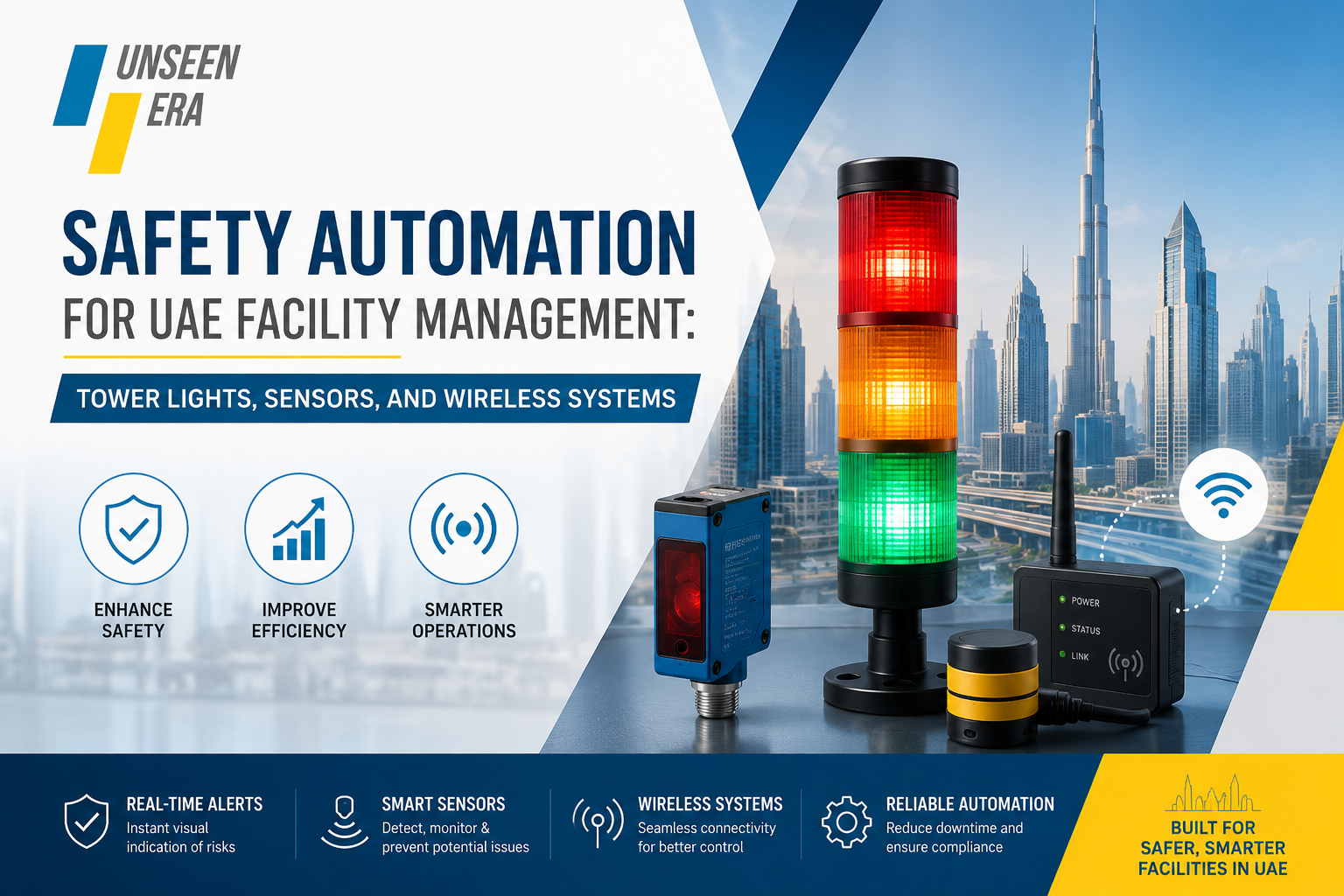
The modern day UAE based facilities need to meet stringent requirements when it comes to the safety of the employees while maintaining operational efficiency and adhering to industry compliance norms. Be it a manufacturing unit, logistic facility, commercial building or even an industrial warehouse, facility managers rely onsmarttechnologysto cut back on risks, prevent operational breakdowns and also enhance workplace productivity. The demand for safety automation for UAE facility management is no longer an add-on feature, but has become an intrinsic part of operations.
Safety automation integrates technology such as tower lights,industrial sensors and wireless systems for providing an added benefit of constant surveillance and real-time alerts & communications across a given facility.
The systems will provide facility managers with the ability to detect problems before they occur, react promptly in case of emergencies and maintain overall visibility across all ongoing processes. Industries across the UAE are steadily adapting to digital technologies and smart facility management practices. Here, we discuss how tower lights, sensors, and wireless safety systems aid in smarter and more efficient facility management in the UAE, what are their advantages, practical uses, and how Unseen Era is driving smart and reliable safety automation solutions for modern facilities.
Table of Contents
What is Safety Automation in Facility Management?
Automated safety is an advanced workplace safety management system using the latest technologies to automatically identify workplace dangers and alert the relevant people, which minimizes human errors while minimizing operational safety hazards. Systems for Automated safety are intelligent systems like industrial sensors, tower lights, wireless communication, monitoring systems and alarms which work together to create the connected Safety Ecosystem which allows businesses to reduce the incidence of workplace incidents while continuing business without interruption. The Safety Automation can detect potential issues in equipment, Machinery, machinery conditions and industrial surroundings automatically by taking regular snapshots of machinery.
By collecting constant real-time data from sensors to prevent potential safety threats, and notifying everyone around, this kind of SafetyAutomationcan reduce costs of major industrial accidents and even protect businesses from major safety risks that lead to downtime.
In the present era where digital is the future, companies like those in UAE are taking on digitalization to get benefits of technologies in safety automation, whether those are commercial buildings, industrial plants, manufacturing units, Warehouses, or Healthcare, logistics, and oil and gas companies.
Tower Lights, Sensors and Wireless Systems: The First Line of Visual Communication
Tower Lights: The First Line of Visual Communication
- Among the various industrial processes in the workplace, effective communication is vital, especially when it comes to safety. In a high-volume industrial environment where workers are often exposed to many different moving parts, machines are in operation, and safety conditions can quickly change, a workforce needs a way to immediately identify equipment status, warning signs, and emergencies.
- To solve this, tower lights, industrial sensors, and wireless solutions have worked together to be the first line of communication in many industrial environments.
- A Stack Light, also commonly known as a tower light, stack light or signal light is a type of visual signaling device consisting of a series of lights to be illuminated one by one in specific sequence or pattern to transmit the operating status of machines or any work environment.
- Common signaling sequences use different colored lights. These are most commonly color-coded; green for the standard operations, yellow for maintenance required, and red for a warning that signals a potential malfunction or emergency that requires the attention of an operator.
- Tower lights can be combined with a sound to provide audio signal along with light indication in a noise environment to get the attention of operators in assembly lines, automated plants, and manufacturing facilities to reduce downtime.
Industrial Sensors: The First Line of Visual Communication
- Industrial Sensors Industrial sensors are like the eyes and ears of today’s safety automation systems. These devices tirelessly collect information about operating conditions and performance of the machine while monitoring their surrounding environments.
- Common sensor types include:
Temperature sensors
Pressure sensors
Proximity sensors
Motion sensors
Gas detection sensors
Photoelectric sensors
Vibration sensors
Wireless Safety Systems: The First Line of Visual Communication
- Wireless Safety Systems Wireless safety systems create a reliable and complex network between various safety devices, eliminating large wiring needs.
- When triggered, alerts and data from these safety devices are relayed back to central monitoring systems and on to the operator, superintendent, or remote team as soon as possible.
- This kind of communication also adds the benefit of being flexible for large sites and remotely managed monitoring to alert the team right to where the equipment is in relation to their current whereabouts.
Key Features to Look for in Safety Automation Solutions
A successful Safety Automation solution is going to need a few different capabilities to get right: First up – the hardware solution must be scalable and dependable to last a long time, and also adaptable for your future business needs.
- Real-Time Monitoring Capabilities Continuous and on-demand machine status and environmental condition monitoring allows operators to take immediate action for safety hazards.
- Intelligent Alert System Visual, audible and remote warnings triggered immediately whenever there are unusual operating circumstances. This is absolutely critical in shortening reaction times, and potentially saving costly production downtime.
- Wireless Solutions Wireless connectivity simplifies system deployment as facility infrastructure doesn’t need costly wiring installation. Remote monitoring of operation from your control room and from your phone or other devices is also a key advantage.
- System Integration Capabilities Solutions must be readily integrable with existing equipment, PLCs, HMIs, SCADA, building automation and IIoT systems.
- System Scalability If the facility has, or will have, more machines, more production lines, additional sensors or devices, then your safety solution needs to scale to meet those needs without extensive redesign or major re-wiring infrastructure.
Best Practices for Successful Safety Automation Deployment
- Perform a Risk Assessment: Analyze your process to understand where the highest safety risks exist, and where you can reduce risks using automation.
- Identify the Right Technology: Choose appropriate industrial tower lights, sensors, and wireless systems to meet the operational requirements of the facility and environment.
- Integrate with Your Infrastructure: Integrate new automation systems, machine controllers, and software to existing infrastructure.
- Educate Your Staff: Train workers to use and respond to the alerts of automated systems, the operation of indicator lights, and emergency procedures.
- Perform Maintenance: Carry out regular updates and calibrations of the system and sensors, along with other equipment inspections and tests, to ensure optimal system function and minimize operational risks.
- Measure Your Results: Implement system performance monitoring tools to assess your current safety system’s efficacy and identify areas for ongoing improvement.
- Implement Emergency Procedures: Equip your employees with comprehensive and effective workplace emergency response procedures and train them how to react when any alarms or indicators go off.
- Consider Future Expansion: Make a long-term investment in a modular automation system that can expand as your facility, processes, and workforce grow.
Why Choose Unseen Era for Safety Automation Solutions?
Automate your Workplace Safety Building a safe, reliable, and future-ready facility starts with choosing the right automation partner. We at Unseen Era offer industry-leading safety automation solutions for businesses in the UAE to improve workplace safety, reduce operational risks, and increase productivity.
- Comprehensive Safety Automation Solutions: Our range of industrial safety equipment includes tower lights, industrial sensors, wireless communication devices, signaling solutions, and automation accessories.
- Unrivaled Industry Expertise: We are committed to understanding your industry challenges and guiding you towards appropriate solutions that address your unique needs, comply with the latest regulations, and align with your overall business goals.
- Premium Quality Products: Partnering with renowned manufacturers, we ensure to supply robust products built for the tough environments of industrial sites.
Frequently Asked Questions(FAQs)
1.What exactly is safety automation in facility management?
Safety automation refers to the application of technological tools such as tower lights, industrial sensors, and wireless technology to persistently observe site circumstances, diagnose hazards, and activate pre-set safety measures to maximize effectiveness and team security.
2.How do tower lights increase safety at the workplace?
Tower lights offer precise and obvious visual as well as audible warnings to signal machinery condition, system failures, forthcoming maintenance, or an emergency, empowering fast reactions and minimizing both productivity losses and potential injuries.
3.What are the advantages of wireless safety systems?
Wireless safety systems often lead to lower setup costs and quicker installation times, enhanced versatility when it comes to growing the system in the future, capacity for remote observing, and direct communication without the necessity of running wires-ideal for today’s businesses.
4.What types of industries benefit most from safety automation technology?
Safety automation technology provides broad advantages and solutions across a multitude of sectors that can include but are not limited to: manufacturing, warehousing, and logistics; oil and gas; food and beverage; pharmaceutical and medical; construction; commercial properties; utilities; and transportation industries.
5.Can I connect a safety automation system with the equipment I already use?
The best safety automation systems can be integrated easily and seamlessly into various common industrial systems, including but not limited to PLC systems, HMIs, SCADA software, and the IIoT platform.
6.How can industrial sensors support predictive maintenance?
Industrial sensors transmit real-time information about operational settings, such as operating temperatures, pressure levels, movements, or vibrations, allowing you to check equipment health and identify potential problems before they lead to significant downtime.