

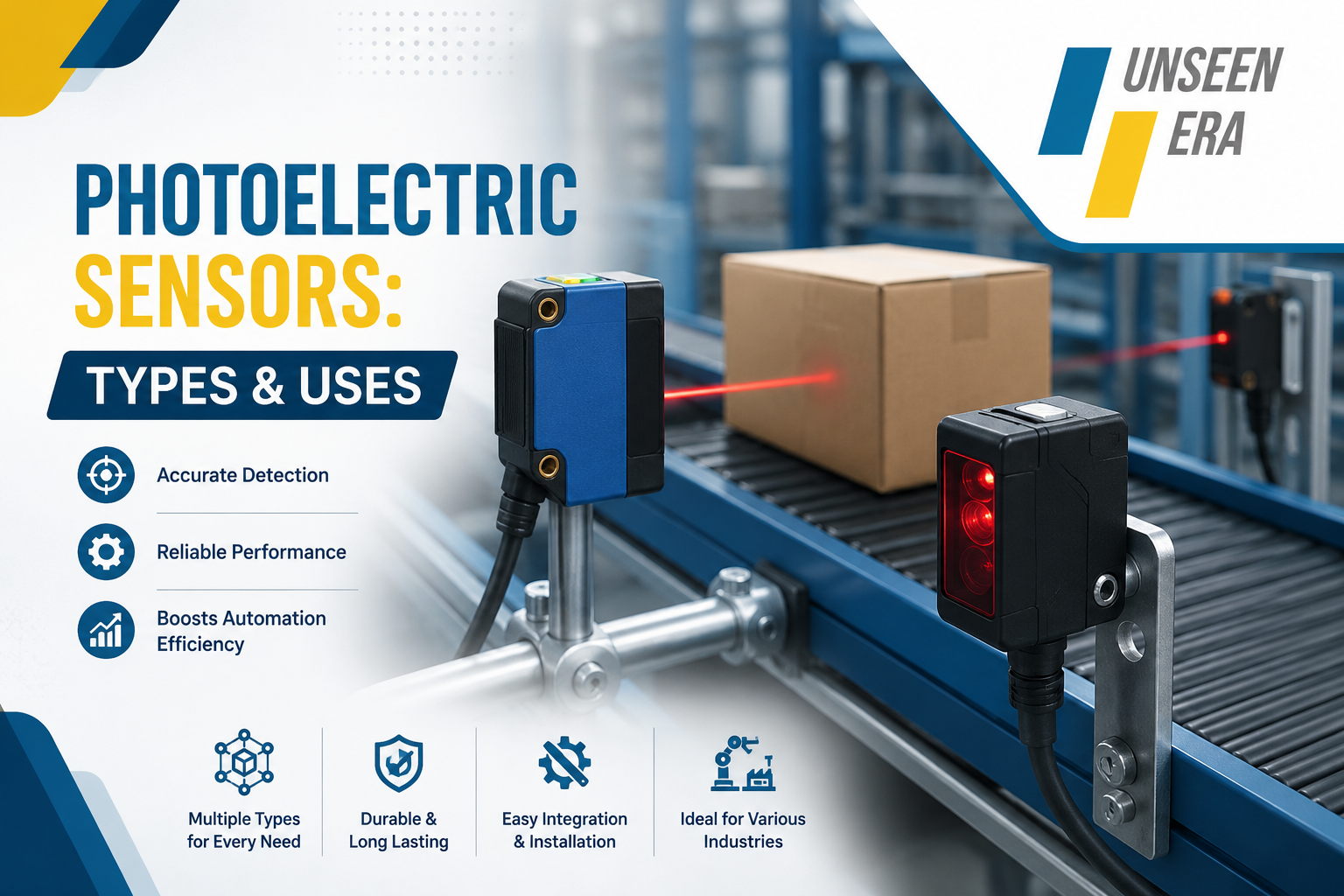
As industrial applications increasingly incorporate automation and sophisticated machinery, the demand for reliable object detection is more crucial than ever. Manufacturing and packaging facilities, automobile production lines, and warehouse operations depend on sensing to streamline processes, ensure quality, and reduce downtime. Among the technologies designed for object detection, photoelectric sensors stand out for their non-contact operation, accuracy at high speeds and over considerable distances.
A beam of light is emitted by photoelectric sensors and is used to detect whether an object is present, missing, or in a certain position, making these sensors ideal for many industrial automation processes. They are highly versatile, extremely accurate, and easy to integrate with industrial controllers, such as PLCs, and robotics for smooth operation. For efficient operation, a high-quality photoelectric sensor solution from Unseen Era can boost productivity.
Table of Contents
What Are Photoelectric Sensors?
A photoelectric sensor is a non-contact electronic sensor that uses a beam of light to detect the presence, absence, distance, or movement of an object. The photoelectric sensor typically uses a beam of light (such as infrared light, red visible light, or a laser light) and detects whether this light is being blocked, reflected, or received. If the object is within range of the photoelectric sensor and interferes with the beam of light, a signal is sent, resulting in a specific action, such as halting a production line, counting items, or controlling a machine.
Photoelectric sensors are used extensively in industrial automation, where quick response times, accuracy, and the inability to touch or alter the detected object are critical factors. These sensors can detect objects made of many different materials, such as metals, plastics, glass, wood, paper, as well as liquids and other translucent materials, depending on the sensor type. Some examples of photoelectric sensors in action can be seen in a number of manufacturing plants, production and packaging lines, automotive factories, warehousing and distribution centers, as well as in food production facilities and pharmaceutical manufacturing.
How Do Photoelectric Sensors Work?
Photoelectric sensors send out a beam of light from an emitter to a receiver. An object interrupts the beam, reflects it back, or modifies it in some way. Photoelectric sensors turn this interruption, reflection, or change in the light into an electrical signal, which can be used to control some automatic machine action, like starting or stopping machinery, counting products, or triggering alarms.
Here is how photoelectric sensors work generally:
- Light Emission: Light is emitted from the photoelectric sensor through an emitter. The light can be infrared light, visible red light, or a laser beam aimed at the desired sensing area.
- Object Detection: As an object enters the sensing range, it blocks, reflects, or modulates the light beam according to the photoelectric sensor type.
- Signal Processing: A photoelectric receiver detects the change in the light signal and sends it to the sensor’s internal electronics.
- Output Signal Generation: Based on the processed signal, the photoelectric sensor sends an output to the connected device, such as a Programmable Logic Controller (PLC), relay, or counter, to signal the change.
Main Types of Photoelectric Sensors
Here are the main types:
Photoelectric sensors
It comes in a variety of types, each catering to different industrial applications. This versatility is driven by factors such as sensing distance, target object properties, and operating environment. Knowing these different types is crucial for businesses seeking reliable and efficient industrial automation.
Through-beam photoelectric sensors
These are the most basic and reliable types of photoelectric sensors. These units consist of two components: a transmitter (or emitter) and a receiver. The transmitter and receiver are placed facing each other, creating a light beam that connects them. An object is detected when it interrupts this light beam.
The through-beam type has the longest sensing range and highest accuracy of all photoelectric sensor types and is therefore the choice for high-speed applications like conveyor belts, packaging operations, and automated production lines.
Retro-reflective photoelectric sensors
It also employs both a transmitter and a receiver within one housing. A reflective target, placed opposite the sensor unit, is used to bounce the emitted light back toward the receiver. An object is then detected when it breaks this reflected beam. Because they have an external reflective surface to work with, retro-reflective photoelectric sensors are generally the easiest type to install and operate.
Diffuse-reflective photoelectric sensors
It features both a transmitter and receiver in a single housing and does not require a separate reflective surface. Rather than relying on reflected light from a dedicated target, diffuse-reflective sensors detect light directly reflected from the surface of an object itself.
Background suppression photoelectric sensors
They are advanced diffuse-reflective sensors that can reliably differentiate between an object being detected and a surface that the object is placed on or in front of. Background suppression photoelectric sensors can therefore perform with high reliability, even with objects of varied colors or textures, making them perfect for robotics.
Fiber optic photoelectric sensors
They are compact, high-accuracy sensors that use the light carrying capability of fiber optic cables to send and receive light signals. The actual transmitter and receiver components are housed remotely, allowing fiber optic photoelectric sensors to detect objects in confined or extreme environments.
Why Choose the Unseen Era for Industrial Photoelectric Sensors?
Choose Unseen Era for a full lineup of high-quality industrial photoelectric sensors that are as precise and durable as they are reliable. Whether you need to detect the presence or absence of an object, precisely position, measure, count, or sort items in manufacturing, packaging, material handling, logistics or process automation applications, our advanced photoelectric sensors provide seamless and reliable performance for your machinery and automation systems. Our advanced photoelectric sensors have rapid response times, long sensing distances, and a rugged construction capable of withstanding demanding industrial conditions. The right sensor selection with Unseen Era means enhanced performance, reduced machine downtime and improved work-area safety.
Frequently Asked Questions (FAQs)
- What’s a photoelectric sensor used for?
Photoelectric sensors are utilized to identify whether an object exists, is moving, has moved, or has been positioned, without direct physical contact. They’re frequently applied in a range of industries like: automation, packing, material handling, auto production, and the examination of the quality of products.
- What are the different kinds of photoelectric sensors?
The three different types are through-beam photoelectric sensors, retro-reflective photoelectric sensors, and diffuse reflective photoelectric sensors.
- How can photoelectric sensors operate?
Photoelectric sensors create a light beam as well as screen changes to this beam, such as interruptions and also reflections. As soon as a variation in light regularity happens, the photoelectric sensor transforms this difference right into an electronic signal to initiate a specific action in the automation system.
- What advantages exist in making use of photoelectric sensors?
Some of the many benefits of using photoelectric sensors in the market consist of non-contact detection, a great deal of accuracy, fast action rates, extended sensing distances, minimal upkeep, and also durable efficiency. They operate well in difficult industrial atmospheres.
- What sectors widely make use of photoelectric sensors?
The photoelectric sensors can be discovered in numerous sectors such as auto, packaging, and also food and drink processing, to name a few. Other common industries for photoelectric sensors consist of pharmaceuticals, automation, food, warehouse management, packaging, as well as logistics.
- Why would a person acquire photoelectric sensors from the Unseen Era?
At Unseen Era, we specialize in industrial photoelectric sensors designed for precise and also dependable outcomes in commercial and manufacturing environments. Our wide variety of items, combined with our industry expertise as well as customer support, will make certain that you get the most efficient automation solutions for your particular organization’s requirements.