

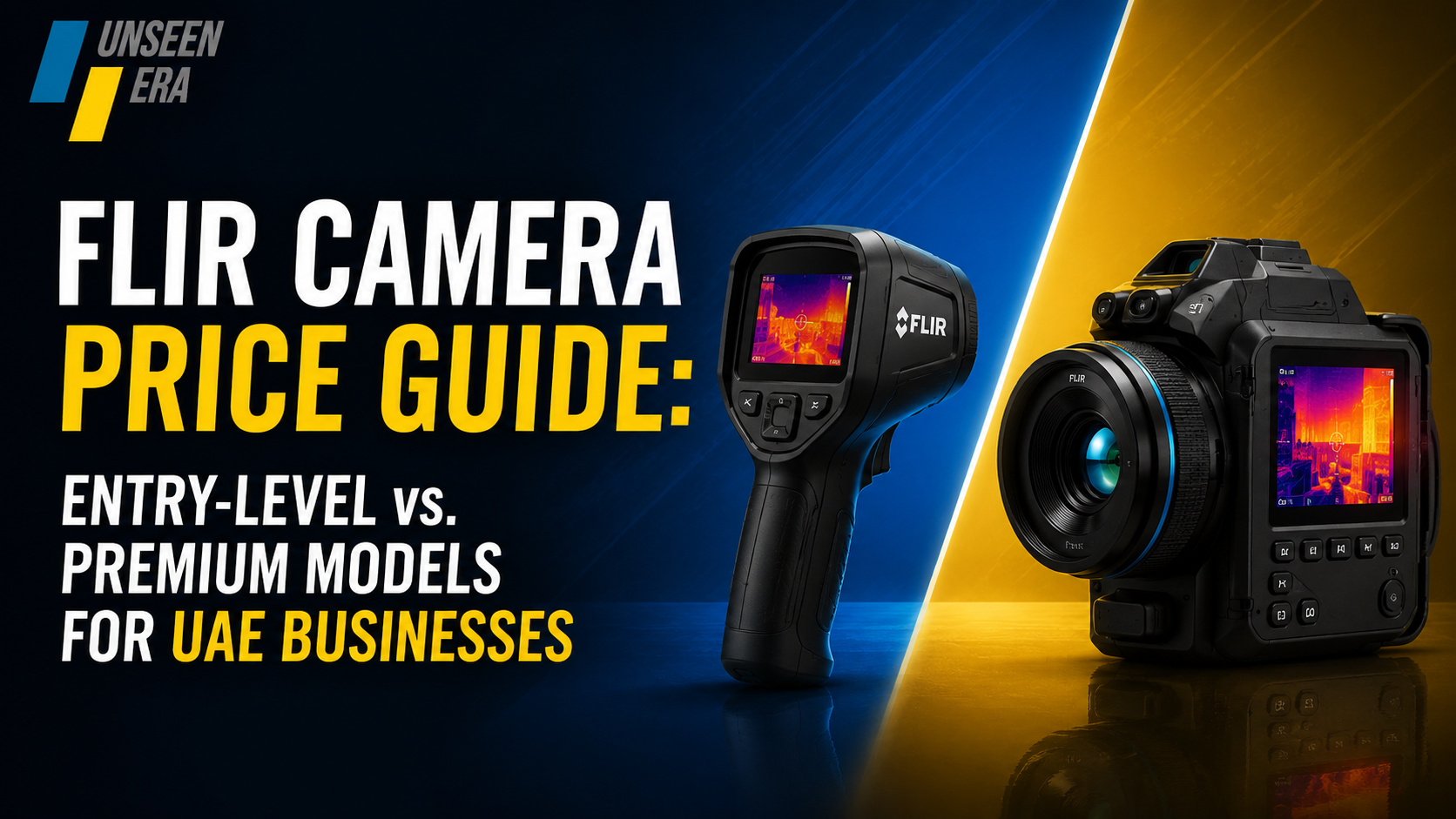
FLIR Camera Price Guide Entry-Level vs Premium Models for UAE Businesses – For manufacturers, inspectors, and facility managers throughout the UAE, selecting a FLIR camera requires alot of checks, however, it all comes down to one last question:how much do you need to spend? With options ranging from several thousands of dirhams to over AED 50,000, the price difference between entry-level and advanced FLIR cameras can be perplexing. The fact that the right choice is based on lesser budget than on your application. Therefore, companies need to understand the complete price guide.
This blog about FLIR Camera Price Guide Entry-Level vs Premium Models for UAE Businesses helps you by providing what distinguishes an entry-level from an advanced FLIR thermal and machine vision camera so that the companies in UAE related to oil & gas, pharmaceuticals, food processing, and transportation can make the right investment at the first attempt.
Table of Contents
Why FLIR Cameras Matter for UAE Industries?
The industrial landscape in the UAE is developing quickly, with growth occurring in the areas of pharmaceuticals, automobile manufacturing, chemicals manufacturing, and FMCG industries. The role of thermal imaging technology is also growing in quality assurance, predictive maintenance, and process automation. Therefore, the FLIR camera technology is widely used for purposes such as:
- The detection of overheated parts in electrical panels before a breakdown occurs
- Quality inspection for products during high-speed production
- Temperature monitoring in difficult environments with high temperatures
- Performing non-contact inspections for food and pharmaceutical purposes.
As the summer temperatures in the UAE are extremely high, thermal imaging technology has proved its worth in preventive maintenance as well, since electrical breakdowns and mechanical issues can also generate heat long before any visible or audible signs of failure appear.
Why Entry-Level FLIR Cameras & What Do You Get for the Price?
The price of entry-level FLIR devices is usually between AED 3,500 and 12,000, according to their resolution and functions. These cameras are designed for straightforward inspection applications rather than complex automated systems.
Main characteristics in entry-level models include:
- Lower thermal resolution (160×120 to 320×240 pixels).
- Average accuracy of temperature measurements (±2°C or ±2% of the reading).
- Simple point-and-shoot handheld application.
- Limited ability to integrate with software for automated data logging.
- Shorter distance of detection suited for close inspection.
Ideal for:
- Small maintenance teams performing random checks on electrical switchboards or engines.
- Facility managers performing inspections of buildings from time to time.
- Businesses make sure of thermal inspections in practice.
Overall, entry-level cameras can perform well regarding simple diagnostic tasks but cannot be used for precision manufacturing and automated inspections.
Why Premium FLIR Cameras & Where Does the Investment Pay Off?
Premium FLIR cameras, which usually cost around AED 20,000 to AED 80,000 or even more, are developed to be extremely reliable, accurate, and integrated with all automated processes. If your business operation requires constant high-speed inspections in areas such as pharmaceutical packaging or automotive assembly lines, these are the models that you will be interested in and will truly see the difference.
Common characteristics include:
- Superior thermal resolution (640×480 and higher) for improved detection of defects
- Tighter margins of error that are important in some regulated industries
- Interfaces compliant with GigE Vision or USB3 Vision for smooth integration with industrial control systems
- Advanced software support with automated alerts, storing data, and complex analysis
- Rugged housings designed to function in tough operating conditions and withstand harsh environments
Since these highest-end devices are usually incorporated into permanent vision systems rather than being used as portable devices, the selection of the interface device is as important as choosing the actual camera. If you are in doubt about your options, then our detailed comparison on choosing the right FLIR camera interface for UAE plants will help you provide a detailed review.
Most effective in:
- Industries where full-time automated quality controls are required
- Operations with strict regulations that require highly precise thermal information
- Oil and gas industry and the energy sector that need early detection of malfunctioning equipment operating in a large area
What Are the Key Factors That Affect FLIR Camera Pricing?
Below are some of the key factors that drives the price up or down. Understanding this will help you in not overpaying for unnecessary features or spending too little on required features.
- Resolution: More pixels give higher resolution and better readings of temperature but incur higher cost.
- Frame rate: Higher frame rates are needed for high-speed factories and attract higher cost.
- Lens types: Equipment with interchangeable lenses (macro, telephoto or wide) offers a higher degree of versatility and involves a higher price.
- Software and connectivity: Cameras designed for automatic integration with other systems hit the market with a higher price tag.
- Durability rating: Cameras with an IP rating or a robust body designed for use in an industrial environment are more expensive than consumer cameras.
- Certifications: Cameras used in hazardous locations such as gas and oil sectors in the UAE need to be certified, which incurs a higher price.
If your company is looking at various types of cameras and not only thermal units but standard machine vision equipment too, you can review our guide on line scan vs area scan cameras, since the right type of sensor defines the FLIR camera suitable for your production line.
How to Choose the Right Tier for Your Business?
Rather than defaulting to the cheapest or the most expensive option, match the camera to your actual operational need:
- If you need occasional spot inspections: An entry-level handheld FLIR camera is likely sufficient and cost-effective
- If you’re running continuous, automated inspection on a production line: A premium camera with GigE or USB3 Vision integration will deliver the reliability and data consistency your process requires
- If you’re in a regulated industry like pharmaceuticals or food & beverage: Premium models with tighter accuracy and documentation capabilities are almost always worth the added cost
- If you’re unsure where you fall: Start with a needs assessment—resolution requirements, environment, and integration needs will naturally point you toward the right tier
It’s also worth considering total cost of ownership rather than just the upfront price. A premium camera integrated properly into your vision system can reduce downtime, catch defects earlier, and pay for itself through fewer production line stoppages and reduced maintenance costs.
Final Thoughts
There is no universally best FLIR camera that is made for your specific application, environment, and budget. Companies in the UAE that deal in pharmaceuticals, chemicals, automotive and logistics have different needs and the price for their entry-level or premium models can also differ in resolution, accuracy and integration capability,
Therefore, for companies that are building a broader vision system rather than just a standalone camera, we hope that this blog helped you understand your needs and what model should you pick across all prices.
FAQs (Frequently Asked Questions):
1) What is the average FLIR camera price in the UAE?
Entry-level FLIR cameras generally range from AED 3,500 to AED 12,000, while premium industrial models can cost AED 20,000 to AED 80,000+, depending on thermal resolution, accuracy, software integration, and industrial certifications.
2) Which industries in the UAE benefit the most from FLIR cameras?
FLIR cameras are widely used in oil & gas, pharmaceuticals, food processing, automotive, power generation, manufacturing, logistics, and facility management for predictive maintenance, quality inspection, and process monitoring.
3) Does Unseen Era supply FLIR cameras in the UAE?
Yes. Unseen Era supplies a range of FLIR thermal and machine vision cameras for industrial applications across the UAE, helping businesses choose solutions that match their inspection, automation, and maintenance requirements.
4) Can Unseen Era help select the right FLIR camera for my application?
Absolutely. Unseen Era provides expert consultation to recommend the most suitable FLIR camera based on your industry, required resolution, operating environment, software integration needs, and budget.
5) Are premium FLIR cameras worth the higher investment?
Yes, if your operations require continuous monitoring, automated inspections, or highly accurate thermal measurements. They often reduce downtime, improve quality control, and deliver a strong long-term return on investment.
6) Can FLIR cameras detect equipment issues before failures occur?
Yes. FLIR thermal cameras identify abnormal heat patterns in electrical and mechanical equipment, allowing maintenance teams to detect potential faults early and prevent costly breakdowns.