

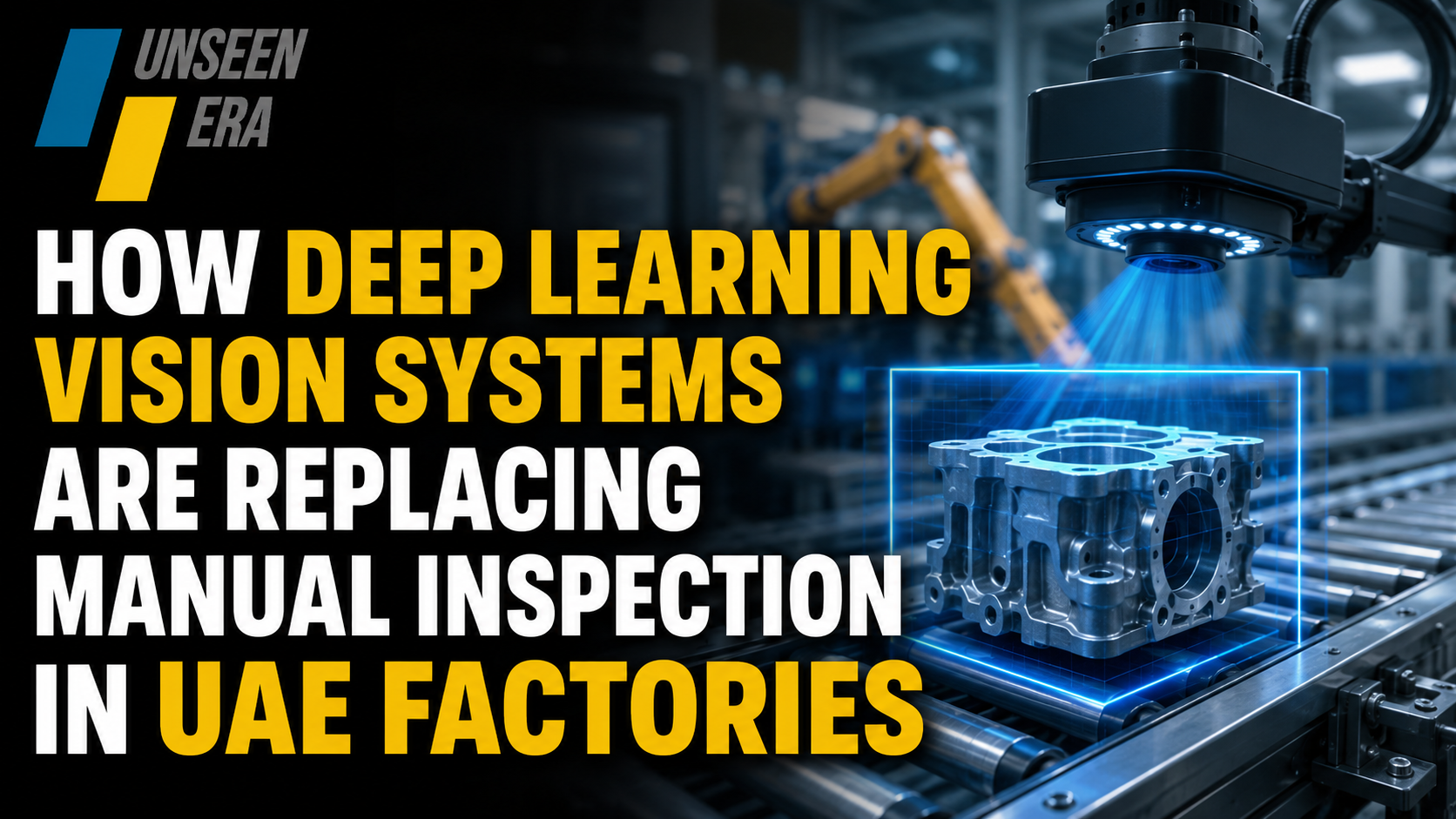
The manufacturing industry in the UAE is currently evolving rapidly through increased output, pace of production, and quality control, specifically in the areas of pharmaceuticals, food & beverage, automotive, and electronics. Over the years, all the methods of performing quality control inspection relied heavily on human inspectors physically reviewing items as they moved along production lines. Although this technique did make sense for many years, but not anymore.
By using smart vision sensors trained via deep-learning vision technologies offered by Unseen Era, the way goods are being produced will change in the UAE. With the fusion of high-definition imaging with deep learning vision systems and customised vision solutions, companies will be able to replace manual inspections with automatic visual inspections done by a deep learning vision system 24/7. The transition from manual inspections to deep-learning visual inspections within factories throughout the United Arab Emirates is not a new trend; rather, it is in the process of becoming a common practice in the manufacturing sector throughout the world.
Table of Contents
Why Is Manual Inspection Reaching Its Limits?
Analogue inspection has proven an effective means of inspection over the course of time, but it has inherent limitations that will be magnified as volume increases.
- Inspection Fatigue & Product Variability: The longer an inspector works, the less accurate they become at detecting defective products because each day produces different defects on each machine, which could lead to a pass one day and a failure another day.
- Subjectivity: Two inspectors can evaluate the same object and come up with different evaluations of the same object, leading to subjectivity in quality standards being established.
- Speed Limitations: In industries such as food, pharmaceuticals, and electronics, many processes require high-speed production lines that frequently travel at a speed greater than the human eye can track.
- Limited Data Collection: When performing inspection processes manually, there is little to no collection of structured data, which makes investigating the root cause of defects very difficult.
These limitations are even more important for regulated industries like the Pharmaceutical industry, where one mistake could cause a costly recall or non-compliance.
Manual Inspection vs Deep Learning Vision Systems |
||
|---|---|---|
| Parameter | Manual Inspection | Deep Learning Vision System |
| Inspection Speed | Limited by human reaction time | Milliseconds per unit, suited to high-speed lines |
| Accuracy | Drops with fatigue across long shifts | Remains consistent 24/7 |
| Defect Detection | Best suited to obvious, visible flaws | Detects subtle, irregular, and previously unseen defects |
| Consistency | Varies between inspectors | A uniform standard is applied every time |
| Data & Traceability | Minimal structured data generated | Every inspection is logged for trend analysis and root-cause tracing |
| Scalability | Requires hiring and training as volume grows | Scales with software updates and minimal added headcount |
| Regulatory Compliance | Dependent on the inspector’s diligence | Supports consistent, auditable compliance records |
What Makes Deep Learning Vision Different?
Conventional machine vision uses strict set rules to check against a specific list of examples of how a product should look versus how it appears and to indicate any differences. Deep learning machine vision, on the other hand, has more capability than this because it does not rely on strict rules but instead can be trained on large databases with thousands or millions of pictures so that it can identify many different patterns and types of defects even when the defects are minor in size or shape, and when they have not been seen before.
Some of the advantages that deep learning offers above traditional machine vision systems are as follows:
1) Ability to Identify Patterns Compared to Strict Rules: The deep learning system learns about the characteristics of a “good” product and identifies samples that don’t conform to a defined list. For example, the deep learning system can identify a defect that has a unique or different surface finish, or that has contamination, or that has an assembly error.
2) Continuous Learning: As new types of defects are identified, a deep learning system cancontinue to learn, and thus improve its accuracy as it continues to learn from the new defect types that have been added to the training data set.
3) Ability to Detect Multiple Types of Defects at the Same Time: A deep learning system can simultaneously detect several different types of defects using the same camera and models. For example, it can identify surface scratches, misalignment, missing components, and accuracy of labels all in one pass.
4) Speed without Fatigue: The process of inspection occurs in a matter of milliseconds per unit without loss of accuracy through a 24-hour work cycle.
Deep learning is just one part of a broader trend toward industry manufacturing in the UAE where manufacturers are using technology such as robots, data connectivity, and AI to achieve higher levels of quality and throughput.
Applications Across UAE Industries
Deep learning vision cannot be deployed with a single strategy for every application. Though, it can be directed to specific uses depending on which sector it is applied to. Below are some of the sectors these systems are applied to:
1) Pharmaceuticals and FMCG
Vision systems are used for label verification, tablet integrity checks and packaging inspection of products being produced to ensure that regulatory authorities have verification of every point in production prior to putting the product out for sale.
The vision systems confirm the batch coding, expiry date and sealing integrity were confirmed prior to shipping so that there is less of a chance of sending a non-compliant product to the shelf.
2) Food and Beverage
The applications for visual systems include contamination detection, fill level verification and defective packaging inspections. In view of the importance of keeping food safe, the use of automated optical character verification for identifying incorrect labels in products before they become a recall has become a very important issue and is discussed in detail in the section of this guide regarding how OCV systems reduce recall risk in FMCG and food packaging lines in the fast-moving consumer goods (FMCG) factories.
3) Automotive and Electronics
Component assembly verification, surface defect detection, and connector alignment checks benefit from the precision of deep learning models trained on thousands of reference images, catching micro-level flaws that manual checks would likely miss.
4) Logistics and E-commerce
Barcode and label reading at high volume is essential for accurate order fulfilment. As Dubai’s e-commerce sector continues to scale, understanding the difference between barcode formats has become a practical necessity for warehouse and fulfilment teams, a subject covered in this breakdown of 1D vs 2D barcode reading for Dubai e-commerce and FMCG companies.
The Business Case for UAE Manufacturers
Adopting deep learning vision systems is not just a technology upgrade, it is a business decision with measurable returns.
- Lower defect escape rates: Fewer faulty products reach customers, protecting brand reputation.
- Reduced labour dependency: Inspection roles can be redirected toward higher-value tasks like process improvement.
- Better traceability: Every inspection generates data that can be analysed to identify recurring issues on the line.
- Scalability: As production volumes grow, vision systems scale without the recruitment and training overhead of expanding a manual inspection team.
For factories operating in competitive export markets, these gains translate directly into stronger client trust and fewer compliance headaches.
Choosing the Right Vision System
Different vision systems are built to serve different purposes. The right one depends on production speed through the system and the product being produced, as well as the lighting conditions under which products will be inspected and the complexity of the defect to be detected. Smart vision sensors have been growing in popularity throughout the UAE as they offer both ease of integration into existing systems and excellent detection accuracy, as highlighted in this overview on IS7000 smart vision sensor applications within UAE manufacturing industries.
When companies are considering upgrading their vision system, they should also evaluate camera resolution, processing speed and ease of integrating with existing line controls. Having an experienced industrial automation partner like Unseen Era can make this transition much easier for the companies as they begin to incorporate a new system into their existing production process.
Implementation Considerations
Moving from manual to AI-driven inspection is not an overnight switch. A few factors determine how successful the transition will be.
- Training data quality: Models need a representative sample of both good and defective products to perform reliably.
- Integration with existing lines: Vision systems must work alongside current PLCs and conveyor speeds without creating bottlenecks.
- Operator training: Line staff need to understand how to interpret system flags and respond to alerts.
- Ongoing calibration: Lighting changes, camera positioning, and product variations require periodic system tuning to maintain accuracy.
By working with a supplier that understands the hardware and software components of vision systems, the company can greatly reduce the chance of having a poorly calibrated system during the rollout. Unseen Era offers a range of industrial cameras, sensors and custom vision solutions to provide for such integration into diverse manufacturing environments.
Closure
UAE manufacturing has relied on manual inspections for many years, but manual inspections are now becoming inadequate due to modern needs for speed and precision at a higher scale than ever before. Therefore, deep learning vision systems now provide manufacturers with seamless solutions while ensuring that all inspections are consistent, data-rich, and done continuously throughout the day.
Manufacturers and distributors across all industries, including pharmaceuticals, food packaging, and electronics assembly, are now choosing AI-based inspections to remain competitive. With the help of Unseen Era, companies and factories in the UAE will be positioned for future growth with higher quality control and decreased risk of product defects.
Frequently Asked Questions:
1) What are the main advantages of deep learning vision systems over manual inspection?
Deep learning vision systems deliver faster, more consistent, and highly accurate inspections. They detect subtle defects, operate 24/7 without fatigue, and generate valuable inspection data for quality improvement and compliance.
2) Which UAE industries benefit the most from AI-powered vision inspection?
Pharmaceuticals, food & beverage, FMCG, automotive, electronics, logistics, and e-commerce all benefit through improved quality control, reduced defects, and faster production.
3) Can deep learning vision systems detect defects they haven’t seen before?
Yes. Unlike rule-based machine vision, deep learning models learn patterns from large datasets, enabling them to identify irregular or previously unseen defects with high accuracy.
4) How can Unseen Era help manufacturers implement deep learning vision systems?
Unseen Era provides industrial cameras, smart vision sensors, and customised AI vision solutions. Their team helps businesses integrate these systems with existing production lines for reliable, high-performance inspections.
5) Why should manufacturers choose Unseen Era for machine vision solutions?
Unseen Era combines advanced hardware with industry expertise to deliver scalable, accurate, and easy-to-integrate vision systems tailored to diverse manufacturing environments across the UAE.
6) Is replacing manual inspection with AI a worthwhile investment?
Yes. AI-powered inspection reduces product defects, improves compliance, lowers labour dependency, enhances traceability, and scales efficiently as production volumes increase, delivering strong long-term ROI.