

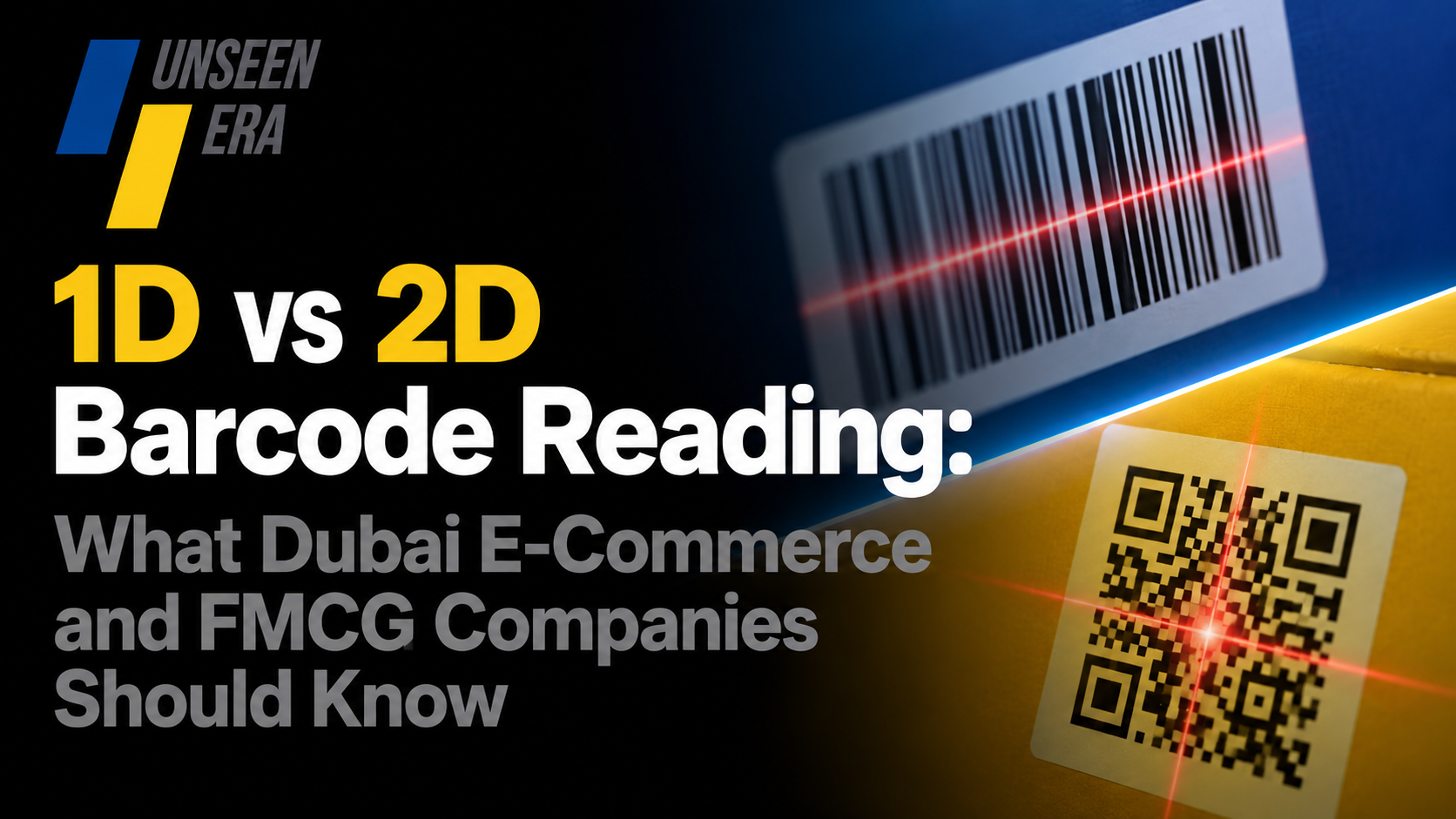
Dubai’s e-commerce industry and the FMCG Industry are growing at such a rapid rate that there is little to no opportunity to operate with inefficiencies. No matter if you operate a multi-SKU Distribution Centre or a FMCG production facility within Dubai Industrial City, every second matters and every scan counts. One key technology in the high-speed environment of e-commerce in Dubai, which is commonly overlooked by those that utilize it, is barcode reading.
Depending on whether you are operating an online retail fulfilment centre or producing packaged goods on a production line, choosing between 1D vs 2D barcode scanning is not merely a technical consideration, but an overall business decision, since each directly impacts accuracy, traceability, and throughput.
Therefore, Unseen Era brings you a complete guide about 1D vs 2D Barcode Reading: What Dubai E-Commerce and FMCG Companies Should Know, so every company makes a mindful decision.
Table of Contents
What Is a 1D Barcode and How Does It Work?
A 1D barcode, also known as a linear barcode, is a code that consists of multiple vertical bars and spaces in different widths, which represent data. To read the barcode, a scanner (through the use of laser or LED lights) shines a beam of light onto the barcode and is able to decode the reflected signals into encoded information.
Some of the common 1D formats are:
- EAN-13 and UPC-A, that are widely used in retail FMCG products
- Code 128, which is also frequently used in logistics and shipping labels
- Code 39, which is highly used in industrial and automotive environments
- ITF-14 is highly common in outer cartons and wholesale packaging
1D barcodes are highly simple, inexpensive to print, and can be easily read using standard scanning devices. However, they can only hold a limited amount of data (usually between 20 and 25 characters long) and can only contain one line of information.
What Is a 2D Barcode and How Is It Different?
A 2D barcode is a type of code that uses an image that stores information using dots and grids of various patterns. 2D barcodes can hold information in both the horizontal and vertical planes, which means they can hold far more data in the same space than traditional one-dimensional barcode versions.
Some of the common 2D formats are:
- QR Code, which is one of the most widely popular codes used for product information & more
- Data Matrix is also heavily used in pharmaceutical packaging and small component labelling
- PDF417 is highly common in logistics, government documents, and transport labels
- Aztec Code, which is used in transport systems
2D barcodes use a series of patterns created from many small geometrical shapes, such as squares, dots, hexagons, etc.
1D vs 2D Barcode Reading Comparison
Below is a comparison table between the 1D and 2D barcodes that tells all of the information about both of the effective methods feature-wise.
| Features | 1D Barcode | 2D Barcode |
| Data Storage Capacity | Up to 20–25 characters | Thousands of characters |
| Structure | Vertical lines and spaces | Squares, dots, and geometric patterns |
| Scan Direction | Horizontal scanning only | Omni-directional scanning |
| Data Types | Mainly numeric and alphanumeric | Text, URLs, serial numbers, batch numbers, expiry dates, images, and more |
| Printing Space Required | Larger | Smaller |
| Damage Resistance | Lower | Higher with built-in error correction |
| Reading Speed | Fast when aligned | Fast from multiple angles |
| Common Applications | Retail pricing, inventory, logistics | FMCG, pharmaceuticals, manufacturing & E-commerce |
| Best For | Simple product identification | Advanced tracking |
Why Does This Difference Matter for Dubai’s E-Commerce Sector?
The Dubai e-commerce industry has grown rapidly over the last few years due to a young, tech-savvy demographic, a robust logistics network, and cross-border trade. Fulfilment centres process thousands of orders each day; therefore, inventory accuracy, speed of order fulfilment and traceability are more critical than ever before.
As the pace of business continues to increase, more challenges arise for companies that rely on traditional 1D barcodes. More companies must keep track of additional product data, such as batch numbers, expiration dates, serial numbers, and countries of origin; therefore, reading 2D barcodes is a much better option.
The advantages of 2D barcode for Dubai’s e-commerce companies are:
- Greater data storage: Store batch numbers, serial numbers, expiry dates, and product origin within a single compact barcode.
- Reduced labelling complexity: Eliminate the need for multiple labels by consolidating essential information into one 2D code.
- Omnidirectional scanning: Operators and automated barcode readers can scan codes from virtually any angle, reducing scan failures on high-speed conveyor systems.
- Improved warehouse efficiency: Faster and more accurate barcode reading helps minimise picking errors, inventory discrepancies, and order returns.
- Enhanced customer experience: QR codes can direct customers to product pages, warranty registration, user manuals, and authenticity verification, adding value beyond the purchase.
- Better scalability: As order volumes grow, 2D barcode reading supports faster fulfilment and improved operational efficiency without increasing manual effort.
Why Does This Difference Matter for Dubai’s FMCG Companies?
For FMCG businesses in Dubai and other parts of the UAE, selecting a barcode is closely tied to compliance with legislation. The UAE Ministry of Health and the Gulf Standards Organization have progressively moved toward requiring serialized and traceable coding on pharmaceuticals and food products. Serializing and traceability of product data such as expiration date, lot number and manufacturer information cannot easily be accomplished with 1D barcodes.
Advantages of 2D barcode in the FMCG industry are:
- Serialization Conformity: For the pharmaceutical industry, 2D Data Matrix codes are the best choice because they provide item-level identification on a unique basis.
- Expiry Date Verification: 2D readers can automatically take the date off of packaging in real-time.
- Small Label Area: Data Matrix code occupies only a small fraction of the packaging of sachets, blisters, vials, or single-serve containers while still maintaining a larger amount of data than a standard 1D barcode.
- Damage Tolerance: The physical environment of manufacturing markets for fast-moving consumer goods (FMCG) will expose the labels on the products to extreme temperatures. Therefore, 2D Data Matrix codes will still be decodable under those same conditions.
Choosing the Right Barcode Scanner for Your Operation
Choosing a specific barcode format requires matching it to the hardware required to scan that format, and vice versa. Organisations that have upgraded from one-dimensional scanning systems to two-dimensional systems have found it necessary to invest in readers based on imaging technology, as traditional laser-based scanners cannot decode two-dimensional barcodes. Some of the barcode scanners that are listed below:
Recommended Barcode Scanners Based on Business Needs:
Below is a table that provides suitable barcode scanner types for all business needs across E-commerce and FMCG companies.
| Business Requirement | Recommended Scanner Type |
|---|---|
| Retail checkout and basic inventory | 1D Laser Barcode Scanner |
| Warehouse inventory management | Handheld Image-Based Barcode Reader |
| Warehouse inventory management | Fixed-Mount Barcode Reader |
| FMCG production lines | Fixed-Mount Barcode Reader |
| Pharmaceutical packaging | 2D Data Matrix Scanner |
| E-commerce fulfilment centres | Combination of Fixed-Mount and Handheld Readers |
| Automated sorting systems | High-Speed Industrial Barcode Reader |
These systems are designed for use in Dubai’s fast-moving consumer goods (FMCG) manufacturing and e-commerce fulfilment facilities, and the common environmental conditions found in these types of facilities, such as variable quality of labels, fast conveyor speeds, and integration of ERP and warehouse management software applications.
When Can You Choose 1D and When to Move to 2D Barcodes?
Not all operations will need to change completely from a laser-based system to an imaging-based system. Your labels should communicate what they need to communicate based on what your workflow requires.
Choosing Between 1D and 2D Barcode Reading |
|
|---|---|
| Choose 1D Barcode Reading If | Choose 2D Barcode Reading If |
| Products only require SKU or pricing information | Products require serial numbers, batch numbers, or expiry dates |
| Existing laser scanner infrastructure is sufficient | Compliance with food, pharmaceutical, or customs regulations is required |
| Printing costs need to remain minimal | Packaging space is limited |
| Product traceability is not a priority | Full product traceability is essential |
| Warehouse operations are relatively simple | High-speed automation and multiple scanning are required |
| Legacy systems still meet business needs | You want future-proof operations with smart tech |
Future-Proofing Your Company’s Barcode Strategy in Dubai
In the UAE, the direction for innovation in regulation, logistics technology, & consumer expectations is dominated by the push for increased data, more robust traceability and heightened automation capabilities. In light of Dubai’s vision for becoming a global smart logistics hub, combined with increasingly strict product traceability legislation, companies using only 1D barcodes should have an established migration path towards full utilisation of 2D barcode technology.
There is no need to replace everything all at once. Rather, the phased approach to making the transition, starting with the highest compliance, highest volume product lines or fastest fulfilment processes, will allow you to gain experience using 2D barcodes & provide measurable ROI with each phased implementation before moving to other areas.
Automation solution providers specialising in barcode reading technology, such as Unseen Era, can assist you in evaluating your current barcode reading capabilities, making appropriate recommendations on the combination of fixed and mobile barcode readers needed, and aligning your scanning capabilities with current operational requirements & future growth requirements.
Frequently Asked Questions
1. Can a 2D barcode scanner read both 1D and 2D barcodes?
Yes. Most modern image-based barcode scanners can read both 1D and 2D barcodes, allowing businesses to support legacy systems while benefiting from advanced barcode technologies.
2. Which barcode type is better for Dubai’s e-commerce and FMCG industries?
While 1D barcodes are suitable for basic inventory management, 2D barcodes are the preferred choice for businesses that require product traceability, regulatory compliance, faster scanning, and higher data storage capacity.
3. Do businesses need to replace their existing barcode scanners when switching to 2D barcodes?
In most cases, yes. Traditional laser scanners are designed for 1D barcodes, whereas 2D barcodes require image-based barcode readers capable of decoding more complex barcode formats.
4. What barcode scanning solutions does Unseen Era provide?
Unseen Era offers a wide range of industrial barcode scanning solutions, including fixed-mount barcode readers, handheld barcode scanners, and high-performance image-based readers designed for e-commerce, FMCG, logistics, and manufacturing environments.
5. How can Unseen Era help businesses upgrade their barcode reading systems?
Unseen Era helps businesses evaluate their existing barcode infrastructure, recommend suitable scanning solutions, and integrate barcode readers with ERP, WMS, and production systems to improve efficiency and accuracy.
6. What are the biggest benefits of upgrading from 1D to 2D barcode reading?
Upgrading to 2D barcode reading improves traceability, supports regulatory compliance, reduces scanning errors, enables faster warehouse operations, and allows businesses to store significantly more product information within a compact barcode.