

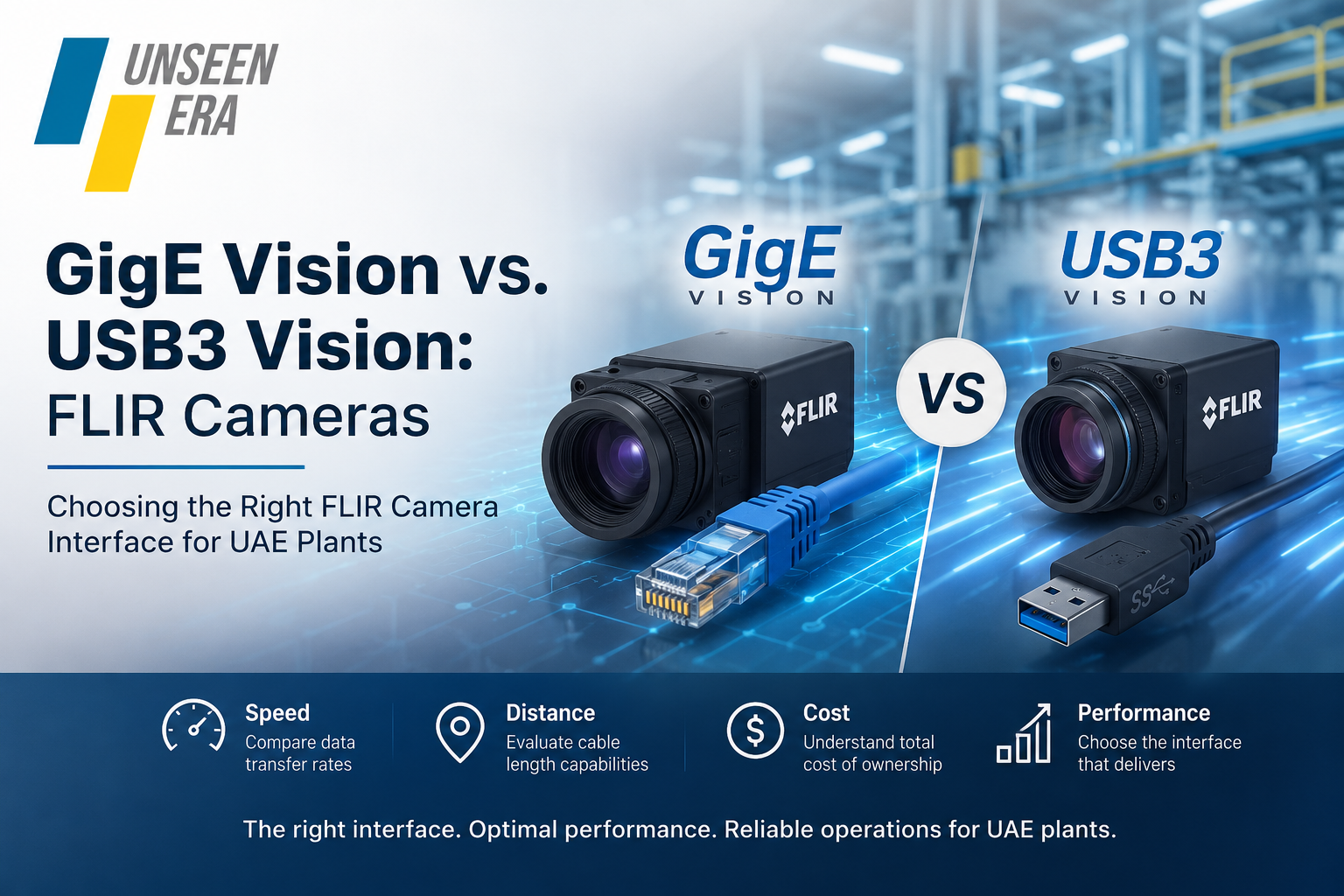
From pharmaceutical, electronic, and food & beverage production to logistics and oil and gas operations located throughout the UAE and Middle East, modern manufacturing plants are increasingly deploying automated solutions featuring machine vision cameras, smart inspection systems, and intelligent software to boost production throughput and maintain unparalleled levels of consistency in product quality. Crucial to machine vision setups is the industrial camera, and understanding how to transmit high-speed data between the camera, frame grabber, and host PC through its camera interface is a critical design consideration.
Many FLIR industrial cameras provide both interface standards, GigE Vision and USB3 Vision, and for the uninitiated, it can seem a prospect to make the right selection based on your individual speed, distance, bandwidth, scalability and cabling and integration needs. However, there are key differentiating factors in each, and making the incorrect choice may lead to bottlenecks in data throughput, significant infrastructure overhead, and potential problems for your inspection system’s future expansion.
In this guide, we’ll compare GigE Vision vs. USB3 Vision, looking at their features, strengths, and limitations, use case scenarios, and help you make informed choices. We’ll even discuss how Unseen Era can help facilitate intelligent machine vision systems for businesses of all industries throughout the region with the range of industry-leading FLIR cameras available, and its expert guidance.
Table of Contents
Benefits of GigE Vision Cameras for UAE Manufacturing Plants
Here are the benefits of GigE Vision cameras:
- Companies throughout the UAE are increasingly opting for GigE Vision cameras in their factories due to a combination of factors, including their high-speed capabilities, extended cable lengths, and effective nature in complex industrial applications.
- From quality control and robotic systems to packaging and process automation, GigE Vision cameras facilitate rapid and efficient visual feedback in modern smart factory environments. Their performance extends into robotic, vision, and automation equipment to the tune of high resolutions across hundreds of meters of data with extremely reliable output.
- One of the major benefits of GigE Vision cameras is their ability to transport high-resolution images over 100 meters using a standard Cat5/Cat6 Ethernet cable without the need for additional amplifiers, ideal for factories with extensive product lines.
- GigE Vision cameras are highly scalable as well since multiple devices are compatible to run in the same environment. Power over Ethernet, as a supplement with GigE Vision cameras, has a great capacity to transfer and power signals through a single cable to save installation time.
Benefits of USB3 Vision Cameras
The perfect USB3 Vision cameras are an ideal option in the sector of industrial machine vision with super-fast image transfer times and the desire for low latency, as well as effortless installation at the same time. The machines in these industries operate using USB 3.0 to be incorporated in the manufacturing and also electronics sector, the biomedical industry, and automated solutions. Additionally, the product can be put to use in areas such as the examination of equipment, precision, and more. Some advantages of USB3 Vision cameras are as follows:
- The most significant advantage of USB3 Vision cameras is their impressive speed when it comes to transferring images.
- These cameras will provide images at remarkable resolutions in real-time frames without a long delay, making them highly practical in inspections.
- USB3 Vision cameras provide a much more reliable connection in terms of performance and latency at the time of image capture and transfers compared to other standard USB types for imaging products.
- Their flexibility provides for simpler construction of camera setups, and they enable the operator to build better working set ups in terms of design and simplicity to set up a camera setup for machine vision applications.
Factors to Consider Before Choosing Between GigE Vision and USB3 Vision
Choosing between a GigE Vision or a USB3 Vision camera interface actually depends on a variety of factors-your manufacturing environment, your application needs, and your long-term planning considerations. Both interfaces are capable of delivering great results, but here are some things to consider.
- Installation Distance
GigE Vision can handle distances of up to 100 metres over standard Ethernet cables, so it is well suited to large manufacturing lines and factory floors. USB3 Vision generally supports cable lengths of 3-5 metres without extenders, so it is better suited to small workstations.
- Image Resolution and Frame Rate
When your application demands very high speed with low latency, it is usually better to choose USB3 Vision. If the application involves high definition imaging from multiple cameras, GigE vision is good reliable service over longer distances.
- Number of Cameras
Scalability (multiple cameras) Ethernet switches make it easy to power a multicamera solution. In addition to being useful for single-image or small inspection systems, USB3 Vision.
- Infrastructure and Installation Costs
GigE Vision employs the general purpose Ethernet medium, and it frequently complements this with the provision of Power over Ethernet (PoE). The use of this protocol can mean fewer wires for connection. However, if you are looking to connect to a number of cameras or to run the camera over a longer length of cable, extra hardware may be necessary.
- Industrial Environment
GigE Vision is most suitable for the installation of big factories, warehouses, and automated production centers due to its long-distance transmission and easy deployment.
- Future Scalability
The possibility of expanding your inspection system by including more cameras or production lines would make GigE Vision much more suitable, as it is more adaptable to future upgrades.
Why Choose Unseen Era for FLIR Industrial Camera Solutions?
When it comes to enhancing your manufacturing capabilities, selecting the right machine vision partner is as critical as choosing the most advanced industrial camera. At Unseen Era, we are your dedicated provider of cutting-edge FLIR industrial camera solutions, equipping businesses throughout the UAE with powerful imaging systems for superior quality control, improved automation, and streamlined production.
Our extensive selection of FLIR cameras, including state-of-the-art GigE Vision and USB3 Vision models, is designed to cater to the diverse needs of various industries. We serve sectors such as automotive, electronics, food & beverage, pharmaceuticals, logistics, and semiconductor manufacturing, providing solutions for high-speed inspections, precision measurements, robotic guidance, and AI-driven automation.
More than just a supplier, Unseen Era offers invaluable technical consultation, ensuring that every FLIR camera solution perfectly matches your production environment, business needs, and long-term automation objectives. From initial system selection and integration assistance to comprehensive post-sales support, we are committed to fostering reliable and effective machine vision systems that drive your success.
Frequently Asked Questions (FAQs)
- Which is better for large manufacturing plants: GigE Vision or USB3 Vision?
The GigE Vision interface is better suited for large manufacturing plants due to the benefits offered through Gigabit Ethernet, such as the ability for single cable transmission of up to 100metres, connection for multiple cameras, as well as a direct integration to other automation solutions in the workplace.
- When should I use USB3 Vision Cameras?
In applications demanding lightning-fast image transferring, the highest levels of latency, and when using short distances from the interface to the cameras, USB3 Vision is the ideal interface to employ.
- Do FLIR cameras have both GigE Vision and USB3 Vision interfaces?
Yes, when it comes to selecting industrial cameras from FLIR, it has become common business practice to select cameras with either GigE Vision or USB3 Vision capabilities, depending on requirements.
- When is the best interface to use for multiple-camera machine vision?
For utilizing multiple cameras throughout your operation, GigE Vision is typically used and will improve its flexibility, given that the system allows for a multitude of IP addresses that connect to your network or through switches.
- Are both GigE Vision cameras and USB3 Vision compatible with my automation platform?
GigE Vision cameras and USB3 cameras are engineered for industrial settings. By using an established interface, such as an Industrial PLC or using popular software platforms for machine vision and artificial intelligence, our 2nd GigE Vision and USB 3 cameras will surely pair perfectly.
- Why use Unseen Era for buying FLIR Industrial Cameras?
We are one of the 10 dealers across the world that carry the most genuine FLIR equipment and supplies to manufacturers in every field and every application to assure a good workflow and the satisfaction you need to be future ready.