

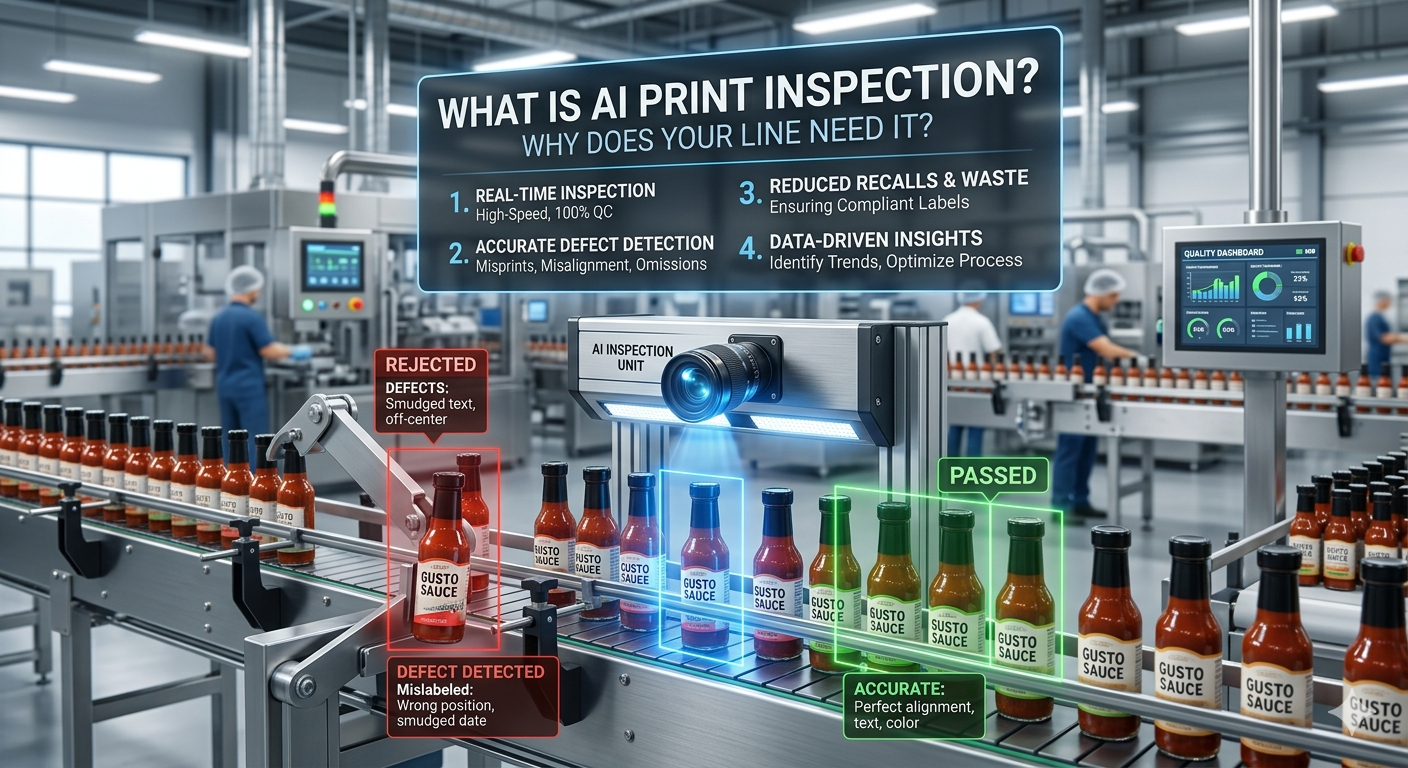
The modern manufacturing industry is rapidly evolving, with AI automation and digital technology driving efficiency. Currently, a tiny printing defect can become a reason for product rejection, customer complaints, or huge loss. That’s why an AI print inspection system is used in modern manufacturing companies. Because it uses computer vision and machine learning to analyze print results dynamically. Instead of relying on fixed parameters, these systems learn from sample data to recognize patterns and identify a wide range of errors that are difficult to find using conventional methods. In this guide, you will know what AI print inspection is, how it works, and why production lines depend on it.
Table of Contents
What Is AI Print Inspection?
An AI print inspection is a technology that reviews each product in real-time and keeps quality steady on high-speed lines. By using advanced image analysis and a machine learning algorithm to automatically detect printing defects during production. It includes:
- Industrial cameras for capturing high-resolution images of printed materials.
- Controlled lighting for consistent and clear images.
- An AI inspection model to analyze texture, shapes, colors, and patterns.
- PLC integration to make fast decisions, like rejecting defective products.
- A monitoring dashboard to show defects, quality data, and production trends in real time.
- Machine vision integration that works with the machine vision system to provide an intelligent inspection solution.
How Does AI Print Inspection Work?
AI print inspection follows a clear technical procedure that supports real-time quality checks on fast lines. Each step plays a crucial role in catching issues earlier and keeping output steady. It combines high-speed cameras, advanced software, and machine learning models. Its working steps are
Image Acquisition:
High-resolution industrial cameras capture images of printed products on the production line using proper lighting setups. This step is the most important for machine vision systems.
Pre-processing and image Enhancement:
Once the first step is done, the system prepares the images for analysis. This step improves the image quality and ensures the AI model receives consistent input data. This step includes:
- Noise reduction.
- Contrast and brightness adjustment. Color balancing.
- Image alignment.
Deep Learning Analysis:
After the completion of the processing step, the system analyzes text, colors, shapes, and alignment to detect defects like blurred printing, missing graphics, or color variations. with advanced models built with deep learning. This enables an inline inspection AI system to monitor the product continuously, even on high-speed production lines.
Decision and Actuation:
After the completion of the analysis step, an AI system immediately sends a pass or fail signal to the production control system. Most factories use Programmable Logic Control (PLC) so the line can respond instantly. All the defective items are removed automatically using air jets, pushers, or diverters. This step ensures defective products are removed without stopping production and maintains efficiency by improving quality.
Data Collection and Reporting:
Modern AI systems also collect and analyze production data. After that, inspection results are displayed through the dashboard, which contains:
- Types of defect data
- Defect frequency.
- Production trends.
- Quality statistics.
These types of systems often connect to MES or ERP platforms, which allow engineers and managers to track product quality, analyze recurring issues, and improve manufacturing processes.
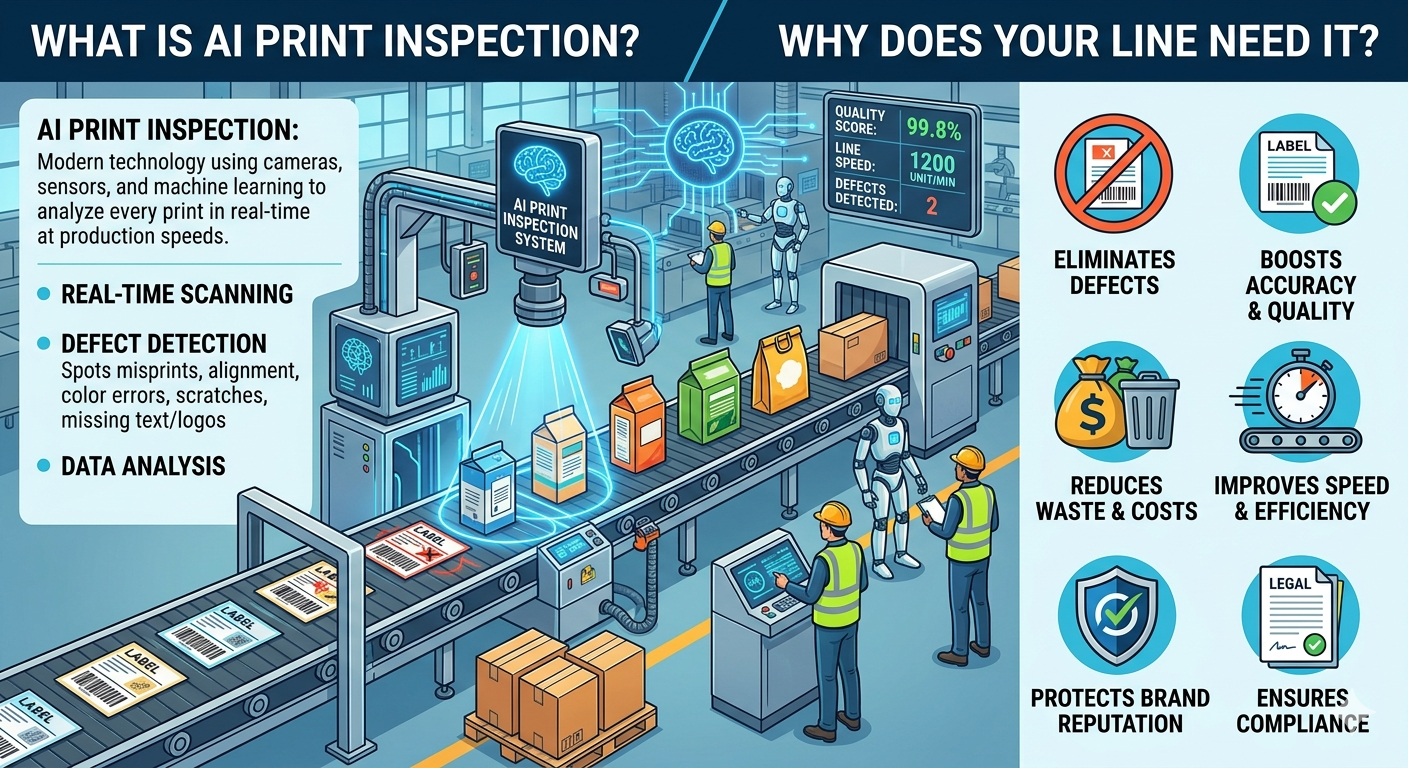
What are the benefits of AI print inspection for production lines?
Some benefits of AI print inspection for production lines are
- An AI system monitors products constantly, reduces human errors, and ensures high standards in quality control.
- It provides a real-time defect detection system.
- It provides high-efficiency products.
- It reduces the rate of defective products and helps to save material and production costs.
- Their system maintains consistent inspection accuracy.
- Its dashboards provide real-time data, defect trends, and quality reports that improve manufacturers’ processes.
- It learns from data and improves over time.
What is the future of AI print inspection?
AI inspection technology is evolving rapidly. So the future system will include:
- Self-learning inspection model.
- Predictive quality control.
- Cloud-based defect analytics.
- Integration with the Industry 4.0 systems.
These innovations in technology will make production lines smarter, faster, and more reliable.
List some AI print inspection technologies used in industries:
- AI-Based Computer Vision.
- Deep Learning Algorithm.
- Machine Vision System.
- Optical Character Recognition (OCR).
- Barcode and QR Code Verification.
- Industrial Vision Cameras.
Conclusion:
AI print inspection is quickly becoming the most usable technology for modern manufacturing production lines. It combines machine vision, deep learning, and automation, which helps manufacturers to ensure flawless print quality at low cost and high efficiency. If your production line still relies on manual inspection, then try AI print inspection that increases your product quality, reduces waste rate, speeds up your production, and helps you to earn more profit in less time.
FAQs Regarding AI Print Inspection and Why Your Production Line Needs It:
Q.1 Which industries use AI print inspection technology?
Ans: Industries like packaging, pharmaceutical, food & beverage, electronics, and cosmetics use AI print inspection technology in their production lines.
Q.2 Is AI print inspection better than manual inspection?
Ans: Yes, AI print inspection is far better than manual inspection. It is faster, more accurate, and more consistent than manual inspection.
Q.3 Can AI detect very small print defects?
Ans: Yes, AI can detect small print defects because it uses machine learning models, which help it to detect tiny defects that humans often miss.
Q.4 How fast can AI inspection systems work?
Ans: Modern AI inspection systems can inspect thousands of products per minute, depending on production speed.